Current localization methods
RSSI and lateration based mostly
RSSI localization methods are based mostly on measuring sign energy from a shopper machine to a number of totally different entry factors, after which combining this info with a propagation mannequin to find out the space between the shopper machine and the entry factors. Trilateration (typically referred to as multilateration) methods can be utilized to calculate the estimated shopper machine place relative to the recognized place of entry factors.
Although one of many least expensive and best strategies to implement, its drawback is that it doesn't present excellent accuracy (median of 2-4m), as a result of the RSSI measurements are inclined to fluctuate in line with modifications within the surroundings or multipath fading.
Fingerprinting based mostly
Conventional fingerprinting can be RSSI-based, nevertheless it merely depends on the recording of the sign energy from a number of entry factors in vary and storing this info in a database together with the recognized coordinates of the shopper machine in an offline section. This info will be deterministic or probabilistic. Through the on-line monitoring section, the present RSSI vector at an unknown location is in comparison with these saved within the fingerprint and the closest match is returned because the estimated consumer location. Such programs could present a median accuracy of zero.6m and tail accuracy of 1.3m.
Its major drawback is that any modifications of the surroundings similar to including or eradicating furnishings or buildings could change the "fingerprint" that corresponds to every location, requiring an replace to the fingerprint database. Nevertheless, the combination with different sensor similar to digicam can be utilized as a way to cope with altering surroundings.
Angle of arrival based mostly

Linear array of antennas receiving a sign. The phase-shift distinction of the obtained sign arriving at antennas equally separated by a "d" distance is used to compute the angle of arrival of the sign. Image reproduced from
With the arrival of MIMO WiFi interfaces, which use a number of antennas, it's attainable to estimate the AoA of the multipath indicators obtained on the antenna arrays within the entry factors, and apply triangulation to calculate the placement of shopper units. SpotFi, ArrayTrack and LTEye are proposed options which make use of this type of method.
Typical computation of the AoA is finished with the MUSIC algorithm. Assuming an antenna array of  antennas equally spaced by a distance of
  and a sign arriving on the antenna array by
  propagation paths, a further distance of
  is traveled by the sign to succeed in the second antenna of the array.
Contemplating that the  propagation path arrives with angle
  with respect to the traditional of the antenna array of the entry level,
  is the attenuation skilled at any antenna of the array. The attenuation is similar in each antenna, apart from a section shift which modifications for each antenna as a result of further distance traveled by the sign. Because of this the sign arrives with a further section of
  on the second antenna and
  on the
  antenna.
Due to this fact, the next advanced exponential can be utilized as a simplified illustration of the section shifts skilled by every antenna as a perform of the AoA of the propagation path:

The AoA can then be expressed because the vector

of obtained indicators as a result of
propagation path, the place

is the steering vector and given by:

There may be one steering vector for every propagation path, and the steering matrix

(of dimensions

) is then outlined as:

and the obtained sign vector

is:
the place
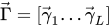
is the vector advanced attenuations alongside the
paths.
OFDM transmits information over a number of totally different sub carriers, so the measured obtained indicators
corresponding to every sub service kind the matrix

expressed as:

The matrix
is given by the channel state info (
CSI) matrix which will be extracted from trendy wi-fi playing cards with particular instruments such because the Linux 802.11n CSI Instrument.
That is the place the MUSIC algorithm is utilized in, first by computing the eigenvectors of  (the place
  is the conjugate transpose of ) and utilizing the vectors equivalent to eigenvalue zero to calculate the steering vectors and the matrix . The AoAs can then be deduced from this matrix and used to estimate the place of the shopper machine by triangulation.
Although this system is normally extra correct than others, it might require particular as a way to be deployed, similar to an array of six to eight antennas or rotating antennas. SpotFi proposes using a superresolution algorithm which takes benefit of the variety of measurements taken by every of the antennas of the WiFi playing cards with solely three antennas, and likewise incorporates ToF based mostly localization to enhance its accuracy.
Time of flight based mostly
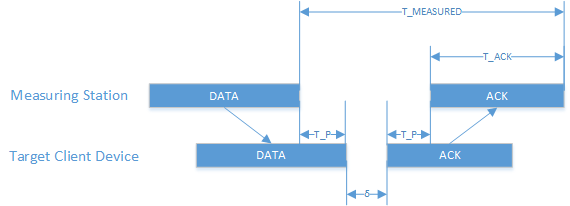
Determine displaying a measuring station sending a DATA body to a shopper station and ready till receiving the ACK.

is the scheduling delay (offset) originated on the goal shopper machine, and it depends upon how a lot time it takes for the ACK to be scheduled. T_P is the sign propagation time between transmitter and receiver, and is normally assumed to be the identical on the best way to the goal and again. T_ACK is the time wanted to transmit the ACK body. The time of flight corresponds to the T_MEASURED. Image reproduced from
This localization method takes timestamps offered by the wi-fi interfaces to calculate the ToF of indicators after which use this info to estimate the space and relative place of 1 shopper machine with respect to entry factors. The granularity of such time measurements is within the order of nanoseconds and programs which use this system have reported localization errors within the order of 2m. Typical purposes for this know-how are tagging and finding belongings in buildings, for which room-level accuracy (~3m) is normally sufficient.
The time measurements taken on the wi-fi interfaces are based mostly on the truth that RF waves journey near the pace of sunshine, which stays almost fixed in most propagation media in indoor environments. Due to this fact, the sign propagation pace (and consequently the ToF) just isn't affected a lot by the surroundings because the RSSI measurements are.
Not like conventional ToF-based echo methods, similar to these utilized in RADAR programs, Wi-Fi echo methods use common information and acknowledgement communication frames to measure the ToF.
As within the RSSI method, the ToF is used solely to estimate the space between the shopper machine and entry factors. Then a trilateration method can be utilized to calculate the estimated place of the machine relative to the entry factors. The best challenges within the ToF method consist in coping with clock synchronization points, noise, sampling artifacts and multipath channel results. Some methods makes use of mathematical approaches to take away the necessity for clock synchronization.


